
FPW Symposium 2026 - Post 6: Half the Conversation Was About Ethics. Nobody Planned It That Way.
- Eric Olsen
- Aug 9
- 4 min read

Bill O'Rourke had been counting. "I've listened to comments yesterday and today," he told the room. "50% of the comments I've heard have been ethical." Nobody had put ethics on the agenda for those earlier sessions. It kept surfacing anyway.

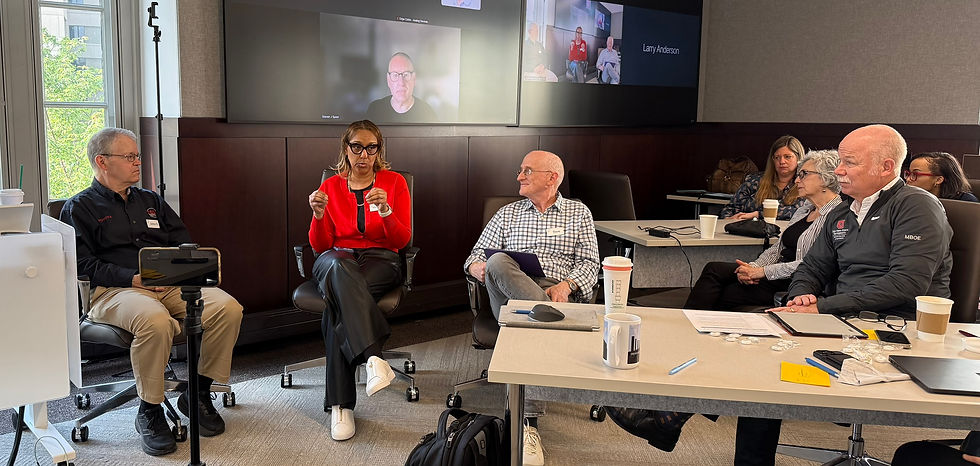
That observation opened the panel that closed our morning at Carnegie Mellon: "AI: Ethics and Leadership Implications." O'Rourke, retired Alcoa executive and author of The Business Ethics Field Guide, was joined by Denise Rousseau, Carnegie Mellon's H.J. Heinz II University Professor and author of Evidence-Based Management, and Dave Lassman, Heinz Distinguished Service Professor of Organizational Management. Vickie Pisowicz of Imagining Excellence moderated. It was less a presentation than a shared wrestling match, and we left with more questions than we brought.
Compliance is the floor, not the ceiling
O'Rourke laid out the familiar map — fairness, bias, transparency, accountability, privacy, safety, human oversight, plus the open question of what any governance body would actually govern. Rules will lag a technology that changes every three months, he argued, so the real work is developing people who think well past whatever regulation arrives. His deeper worry, from decades as an ethics officer and a patent attorney: the hardest part of ethics is recognizing that you have an ethical issue in the first place. Pisowicz put it plainly. We can be compliant without being right.
Reflection is a team sport
Rousseau pulled the thread toward evidence-based management. Situational awareness is not the same as acting on it, she noted, and AI tends to produce the first without the second. Capacity freed from note-taking gets reabsorbed as more workload, not more thinking. Her countermeasure was reflection, done together, because on our own we are "boundedly rational." Teams surface the assumptions we each miss.
Then she connected it back to Steve Spear's session an hour earlier. We only know so much; the capacity to work at the frontier of that knowledge, and sometimes past it, comes from reflection. "That, to me, is the bright red thread in our discussions." The lone knowledge worker grinding away with a chatbot drew her bluntest line: "a professional hell." An evidence-based practitioner, she reminded us, is a reflective practitioner.
Leaders can't abdicate
Lassman aimed at the leadership vacuum. He has watched organizations hand people AI with a shrug (it's here, use it) and called it what it is: an abdication. Leadership means holding the discussion instead. How will we use this? What limits and guardrails do we want? Underneath sat the question he kept returning to: what does it mean to be human in the age of AI? If thinking is what made us successful, what happens when we outsource it, and are we building the character to use these tools well?
The questions we couldn't answer
The open discussion went straight at intellectual property. Tyson Heaton split it in two: the original theft used to train the models, already done, and the unsettled question of attribution. Ken Snyder made it personal. Books he had published were taken into AI training data, and he is part of the resulting class-action suit. What irritates, he said, is the theft itself. Nobody asked. Rousseau asked whether he would accept payment in citations. Probably yes, he said. She proposed treating citation as a currency and normalizing disclosure of AI use the way Carnegie Mellon once laid its sidewalks: seed the grass, watch where students walk, then put the paths there. O'Rourke expected the music-industry path: a collecting body, with fractions of a penny flowing back.
Others raised the environmental cost: the drinking water and energy that data centers consume, which the United Nations lists among AI's largest ethical issues. And Kevin Blue of GILLIG pushed everyone past the talk. Every generation faces its disruption. The question is whether we will put skin in the game.
The most useful moment came last. Asked whether ethics deserved its own FPW initiative, the room answered almost in unison: integrate it. Ethics isn't a separate workstream. It's a thread through all of them, the same way "problems are okay" and safety already run through CI practice. That parallel may be the takeaway worth keeping. We already know how to make hard things discussable, and how to learn from what surfaces rather than punish it. The work now is applying that habit to a technology moving faster than our judgment.
Continue the conversation
If these questions are live in your organization, we'd like to hear how you're working through them, including where you think we've got this wrong. Find us at fpwork.org.
Eric Olsen, FPW Co-Lead
#FutureOfPeopleAtWork #ContinuousImprovement #Lean #ArtificialIntelligence #BusinessEthics #EvidenceBasedManagement #Leadership
Knowledge Map
Process Keywords
ethical risk mapping, evidence-based management, reflective practice, team reflection, leadership accountability, guardrail design, AI-use disclosure, citation and attribution, responsible iteration, governance gaps, character development, compliance versus conscience
Context Keywords
AI adoption pressure, regulatory lag, intellectual-property exposure, environmental and water cost, leadership uncertainty, academic integrity, cognitive offloading, ethics education gaps, disclosure norms, pattern-matching knowledge work
Application Triggers
If your organization is rolling out AI with an "it's here, use it" posture → the leaders-can't-abdicate section offers a frame for the discussion to hold instead.
If you're unsure how to handle student or employee AI use → Rousseau's normalize-disclosure-first approach is a low-friction starting point.
If people on your team are using AI alone → the case for team reflection points to a structural countermeasure.
If you're weighing compliance against doing what's right → the floor-not-ceiling framing separates the minimum from the goal.
If you publish or teach and your work may be in training data → the citation-as-currency discussion is where this community's thinking currently sits.
Related Continuous-Improvement Themes
respect for people, problems-are-okay transparency, systems thinking, reflection and scientific thinking, evidence-based decision making
This post was developed through the whole-room discussion at the FPW 2026 AI & CI Symposium and synthesized with Claude AI assistance. It represents ongoing work by the Future of People at Work initiative, a collaboration of Catalysis, Central Coast Lean, GBMP Consulting Group, Imagining Excellence, Lean Enterprise Institute, Shingo Institute, The Ohio State University Center for Operational Excellence, Toyota Production System Support Center (TSSC), and University of Kentucky Pigman College of Engineering.


Comments