
FPW Symposium 2026 - Post 5: AI Is the Ante. Human Problem-Solving Is the Ace.

Steve Spear put it in one line: the machine won't catch the hesitation in a patient's voice, but a thinking clinician will. That was the thread three practitioners pulled on with the full room at the FPW 2026 AI & CI Symposium at Carnegie Mellon. Facilitated by Dave Lassman of Carnegie Mellon University, the session brought together Spear (MIT), Jamie Bonini (TSSC), and Miranda Mathis-Harris, Chief Nursing Officer at Duke Health Lake Norman Hospital. Each came at the same question from a different side: what does AI actually change about how we compete, how we care, and how we learn?
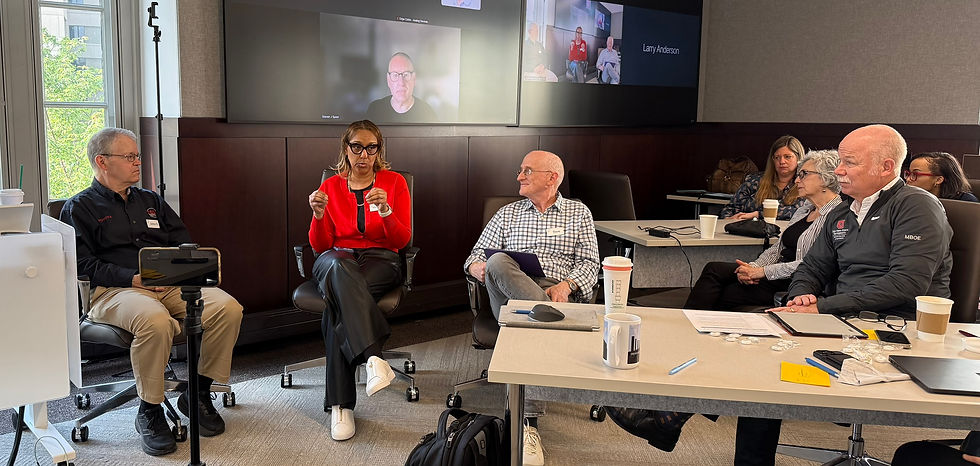
Panel at the Symposium
The frontier AI can't reach
Spear opened with Jared Diamond's Guns, Germs, and Steel. When Pizarro's 168 conquistadors beat an Incan army of 80,000, they won on accumulated, codified knowledge: books, academies, learning shared across centuries and continents. The Incans were expert practitioners inside a smaller domain. At the frontier of what neither side knew, the Spaniards iterated from the deeper base.
AI runs on the same logic. It widens the boundary of the known, everything captured and retrievable. But at the frontier, where local conditions and tacit knowledge define the real work, human intelligence does things the machine can't. AI can surface all that's known about a patient's symptoms. It can't read the dropped head or the thing left unsaid.
Toyota's arc makes the competitive case plain. It started with the Toyopet, a car that fell apart out of the factory at one-eighth the world's productivity standard. Today the RAV4 is North America's best-selling vehicle, and Toyota turns 50% more profit per employee than Volkswagen on about half the direct labor. That came from human problem-solving, not AI. So the line for 2026: AI is the necessary ante. Human intelligence is still the ace.
Eight places AI belongs in the TPS house
Bonini walked the TPS House and named eight spots where digital and AI tools amplify existing practice: remote sensors for Jidoka, condition-based maintenance, AI-enabled manuals, video ergonomic analysis, app-based standardized-work audits, digital Andon boards, digital time studies, and AI video training that captures tacit knowledge from experienced workers.
His principle was blunt: all of it just points to where more problems need skilled people to solve them. Signal amplification is the ante. Human problem-solving is the work.
The eighth application drew the most attention. Across the CI community, decades of hard-won judgment are walking out the door as experienced people retire. Recording how skilled practitioners reason, then deploying it at scale, is a practical countermeasure. It doesn't replace the mentor; it extends their reach.
Every application rests on one thing Bonini named four times: trust. Colleen Soppelsa, from aerospace and defense, turned that into a proposal the room took seriously. The TPS stability layer is usually four M's: Man, Machine, Material, Method. She offered a fifth, mendoumi, the Japanese idea of collective caring, the invisible bonds that hold a team together when cameras and sensors are everywhere. Take the mendoumi out, she argued, and the other four lose their footing.
Where compassion can't be handed off
Mathis-Harris made the stakes concrete. A patient gets a pancreatic cancer diagnosis and chooses treatment. The next day, AI-driven actuarial analysis produces an insurance denial. "Where is that compassion?" she asked. When AI makes the call, do we quietly step out of accountability?
The risk isn't a bad AI decision. It's people using AI's involvement to leave the room morally. She named a second risk beside it: AI trained on historical population data can bake existing healthcare disparities into clinical and coverage recommendations, making unfair outcomes harder to see and challenge. Neither is really a technology-governance issue. Both are leadership issues. Someone still has to own the result, stay in the process, and refuse to let the efficiency math swallow the human stakes.
The question we're still working on
The thread Lassman kept returning to, one that came up earlier in the day too, was this: can we automate a process without offloading the learning? Problem-solving produces the fix. It also builds the practitioner. If AI resolves the signal, who learns? If AI generates the root cause, who develops the judgment to check it?
We left without a settled answer. In the lean tradition, that's not a failure; it's a well-formed problem statement. And it's where we think this community should keep working.
Continue the conversation
If you're wrestling with the same question, we'd like to hear how it's going, including where you think we've got it wrong. Join us at fpwork.org.
Knowledge Map
Process Keywords
knowledge frontier, signal amplification, Jidoka, tacit knowledge capture, TPS stability layer, mendoumi, human-in-the-loop, condition-based maintenance, standardized work, AI augmentation
Context Keywords
AI adoption pressure, deskilling risk, trust culture, leadership accountability, healthcare AI ethics, CI workforce readiness
Application Triggers
If you're deploying AI without a CI process foundation → Bonini's eight-point TPS map is a practical place to start.
If you're worried about tacit knowledge walking out with retiring workers → AI video training (item 8) speaks to it directly.
If you're working with AI in high-stakes or clinical settings → Mathis-Harris's moral-abdication framing is a useful leadership check.
If you're asking whether AI reduces the need for skilled CI practitioners → Spear's frontier model and the Toyota data offer a grounded counterpoint.
Related Continual Improvement Themes
respect for people, organizational learning, standard work, systems thinking, leadership accountability
This post was developed through the whole-room discussion at the FPW 2026 AI & CI Symposium and synthesized with Claude AI assistance. Editorial contributions by Dave Lassman, with additional reviewers credited as comments are received. It represents ongoing work by the Future of People at Work initiative, a collaboration of Catalysis, Central Coast Lean, GBMP Consulting Group, Imagining Excellence, Lean Enterprise Institute, Shingo Institute, The Ohio State University Center for Operational Excellence, Toyota Production System Support Center (TSSC), and University of Kentucky Pigman College of Engineering.


Comments