
Who Decides There Is No Time? Reframing the Improvement Time Problem

This is Part 2 of a four-part series documenting practitioner conversations from the Future of People at Work Lean Coffee session at the LEI Lean Summit in Houston, March 13, 2026. Each post focuses on one of the four cross-initiative themes the community explored: succession planning, time poverty, organizational silos, and AI integration.
At the LEI Lean Summit in Houston, the time poverty breakout table generated 19 sticky notes and one of the most energetic conversations of the session. Practitioners from healthcare, retail, and medical equipment gathered around a question most of us have heard a hundred times: “We don’t have time for improvement.”
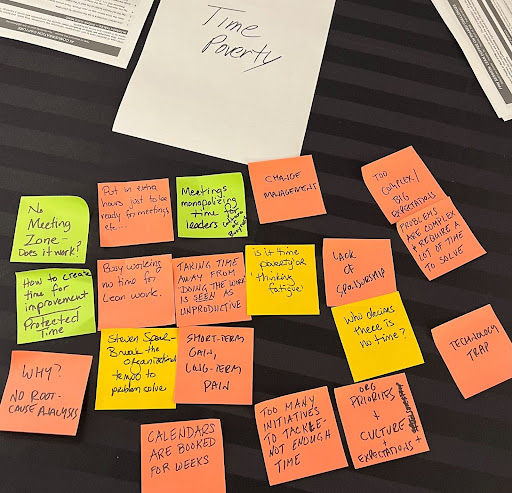
But two questions from the sticky notes reframed the entire discussion. First: “Who decides there is no time?” That shifts scarcity from a condition to a decision. Second: “Is it time poverty or thinking fatigue?” Maybe some of what we call “no time” is really avoidance of the hard cognitive work that improvement requires.
Making Time Non-Negotiable
A healthcare improvement leader described requiring one hour per week with specific roles in the room, tied directly to results the executive team cares about. The framing was straightforward: “For me to achieve these results, I need these people in a room for an hour every week.” It worked because the time was connected to measurable outcomes, not framed as an abstract investment. A retail practitioner described the parallel challenge—customers waiting when the store opens, no natural pause in the day—and the group explored whether closing the store periodically for improvement might signal leadership commitment more powerfully than any memo.
The group also surfaced a second-order problem we don’t hear about enough: one team had actually succeeded in freeing up time through a lean effort, but hadn’t planned what to do with it. “We opened up time. And then what?” Creating capacity without a plan to fill it with improvement work is its own kind of waste.
Other strategies included longer, less frequent deep dives to set strategic direction; maximizing existing meetings by auditing their value (one participant had 30 attendees rate meetings 1–5—nearly all said one); and invoking Steven Spear’s concept of breaking the organizational tempo. The sticky notes also named the “technology trap”: we are busier than ever despite having more technology. Perhaps technology is not giving us time—it’s filling it.
Knowledge Map: Connecting to Your Context
Process Keywords: Protected improvement time, meeting audit, organizational tempo, time-as-decision, cognitive load management, deep-dive planning, virtual collaboration tools, PDSA cycles
Context Keywords: Calendar overload, leadership sponsorship gaps, busyness culture, thinking fatigue, initiative overload, short-term thinking, operational pull, retail/healthcare scheduling constraints
Application Triggers:
Hearing “no time for improvement” → Ask “Who decides there is no time?”
Meetings consuming leader time without value → Meeting audit exercise with post-it rating
Freed up time but no plan for it → Pre-plan improvement capacity before creating it
Technology adding busyness rather than time → “Technology trap” diagnosis and Steven Spear’s tempo concept
Related Continual Improvement Themes: Systems thinking, scientific thinking, leadership commitment, organizational learning, respect for people, standard work, flow disruption and overburden (muri)
This post was developed from practitioner conversations at the LEI Lean Summit Lean Coffee session (March 13, 2026), with voice memo contributions from Naomi Viloria, Zoom breakout recording from Sally Gatlin, and synthesized with Claude.AI assistance. Editorial contributions by Eric Olsen, Rachel Reuter, Colleen Soppelsa, an.d Dave Ostreicher It represents ongoing work by the Future of People at Work initiative, a collaboration of Catalysis, Central Coast Lean, GBMP Consulting Group, Imagining Excellence, Lean Enterprise Institute, Shingo Institute, The Ohio State University Center for Operational Excellence, Toyota Production System Support Center (TSSC), and University of Kentucky Pigman College of Engineering.
Continue the conversation:
Join our monthly community gatherings: https://fpwork.org
Miro Board: https://miro.com/app/board/uXjVKm4rtGI=/?moveToWidget=3458764664033400655&cot=14
People to Connect With: @Naomi Viloria @Bruce Hamilton @Rachel Reuter @Eric O. Olsen
Hashtags: #FutureOfPeopleAtWork #ContinuousImprovement #LeanSummit #TimePoverty #RespectForPeople #LeanThinking


Comments